By Amalia Jamaludin
My journey as a SURE researcher began with an exciting opportunity: meeting with my professor, Dr. Antonious Koumpias, to discuss potential research projects. I didn’t have a specific idea in mind, but I was eager to take on a challenge and dive deeper into my fields of study, software engineering and economics. I was fortunate to meet a professor who saw my potential and was willing to help me grow into it. Even though I didn’t know exactly what I wanted, I knew I was ready to learn and explore.
The research we embarked on was in the field of health economics, an area that was completely new to me. I also had the privilege of meeting another student, Mouhamadou, from Ann Arbor. He was completing a similar summer research experience and became an incredible source of inspiration. Together, we navigated the complexities of research, and with his guidance—particularly with Stata, the statistical software we used for analysis—I gained my first hands-on experience with the research process.
Stata, which is widely used in economics, allows researchers to perform data management, statistical analysis, and create visualizations. Mouhamadou, who has been Dr. Koumpias’ research assistant for the past two years, was particularly helpful in sharing his expertise and guiding me through the intricacies of using Stata efficiently. This process opened my eyes to the ways in which technology, especially software engineering, intersects with fields like economics and healthcare.
As we worked through the project, I realized how much research involves—conducting thorough statistical analysis, manipulating data to reveal insights, and creating visualizations that help others understand our findings. I gained a deeper understanding of models and their outcomes, and my biggest achievement was learning to use Stata effectively.
Despite our different campuses—Ann Arbor and Dearborn—the research opportunities Mouhamadou and I were exposed to were remarkably similar. It was reassuring to know that no matter where we study, we can still engage with important research that has real-world applications. Working on this project deepened my understanding of statistical models, data manipulation, and visualization, and it was incredibly rewarding to see our analysis come together.
One of the most eye-opening lessons I took away from this experience was recognizing the interconnectedness of fields. Technology, particularly software engineering, plays a crucial role in many areas beyond traditional applications. It helps solve complex problems efficiently by integrating equations and models, and this research demonstrated how closely intertwined technology and economics can be.
Another significant realization was the flexibility that economics research offers. Unlike lab-based disciplines, much of our work could be done remotely, as long as we had access to a laptop with the necessary statistical tools. This flexibility was invaluable, especially during the summer, as it allowed me to manage my time effectively while still producing meaningful outcomes. It also underscored the ways in which software engineering can be applied to uncover real-world insights.
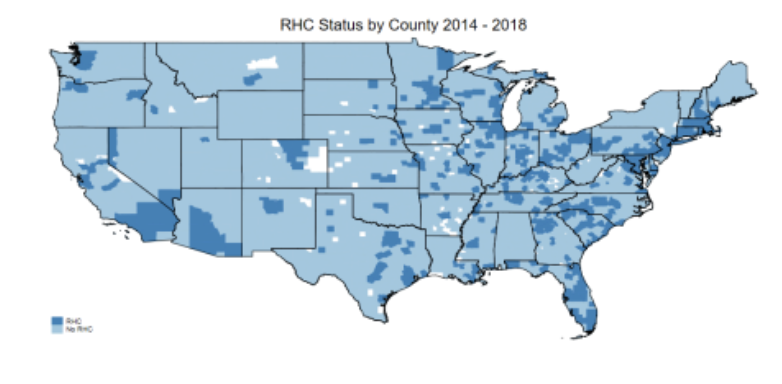
I am particularly proud of the work we accomplished, especially the visualization map I created comparing wait times for medical appointments in counties with and without retail health clinics (RHCs). This visualization provided a clearer understanding of the disparities in healthcare access and underscored the importance of the insights we uncovered. I believe our research offers valuable contributions to understanding healthcare in the United States and highlights the need for further awareness of the systems.
As a first-generation student, I often feel timid and out of place when talking to my peers about their parents’ careers and the insights they have into future career paths. As I navigate university life, I’ve met people from diverse backgrounds, and over time, I’ve realized that we all share a common goal: to create a better future for ourselves. Programs like the SURE research opportunity have been instrumental in bridging the gap, showing me that I too can make meaningful contributions to the world.
