By William DeGenaro and Michael T. MacDonald
Professors of Composition and Rhetoric at UM-Dearborn
There is no single articulation of what we talk about when we talk about first-gen students. There is also no single way that colleges and universities reach out to this population. Some institutions create student life programs, some build academic support structures, some do both, and some pay only lip service, promoting their campus as first-gen friendly without providing support for students who might be multiple-marginalized and are the first in their family to go to college.
No single definition of the term “first-gen” exists. It usually indicates that a student is the first in their immediate family to attend a four-year college or university, the first to attend any college, or a student whose parents attended college but did not complete a four-year degree (to name the most common definitions). The fact that the term “first-gen” is contested reflects the diversity of rhetorics surrounding these students in higher education.
For a more in-depth analysis of “first-gen” as a keyword for higher education, see our book chapter:
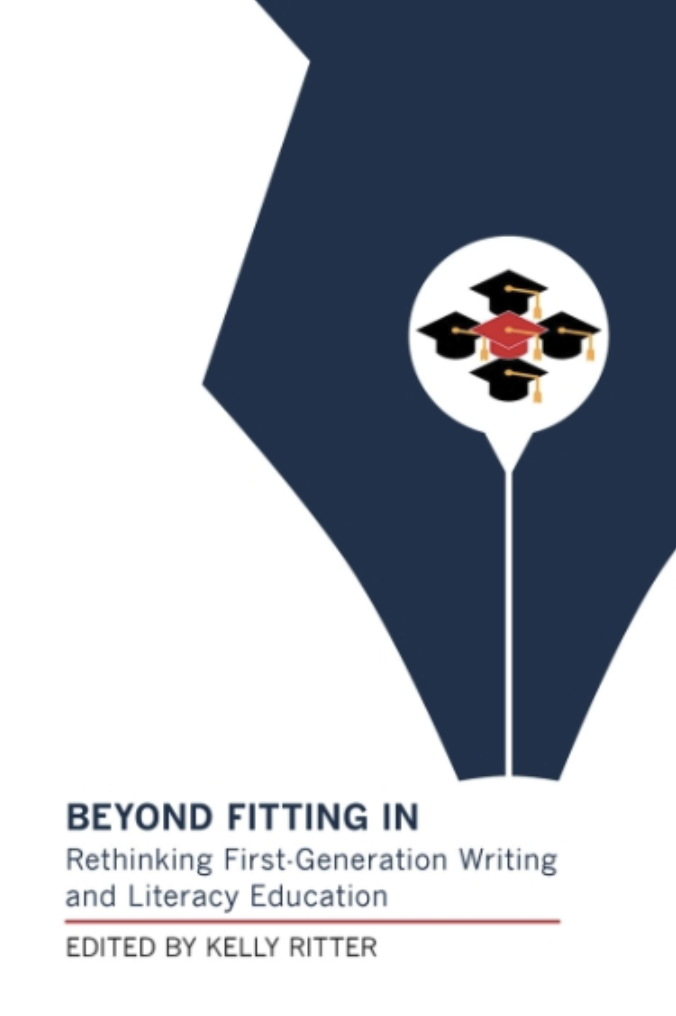
“A Keyword Analysis of Websites That Support First-Generation Students” by William DeGenaro and Michael T. MacDonald, in Beyond Fitting In: Rethinking First-Generation Writing and Literacy Education, edited by Kelly Ritter, 2023, p. 27.
In this chapter, we reviewed university websites intended to support first-generation college students. In doing so, we learned a lot about what we talk about when we talk about first-gen students. As professors at UM-Dearborn, we also saw how the label “first-gen” could not be pinned down to one simple interpretation.
Bill: Confession – I am not a first-gen college student. My dad was an elementary school teacher who went to our hometown college, Youngstown State, early in the Baby Boom era, a time when male high school graduates could easily get jobs in Youngstown’s many steel mills making as much as their dads, which was more than teachers made. He took a different path, a path that seemed providential when all of Youngstown’s mills closed a few decades later. I grew up in the wake of those steel mill closings and developed a lifelong interest in working-class culture and working-class life. As an academic, much of what I study–including the rhetorical practices of working-class people and the educational methods that best serve working-class communities including first-gen students–has its origins in my dad’s story and my hometown’s story.
Mike: I was a first-generation college student who grew up in a very small, rural town in New Hampshire. What was unique about my experience was that unlike some stories of first-gen students in which parents are skeptical about higher education, mine insisted that I go to college so that I could have more opportunities, more of a chance to find a job that would be personally fulfilling. Of course, even as a child I was a nerd and more-or-less liked school so navigating college for me was more of a struggle in terms of financial access. Though, I do remember not liking a course during the first week one semester and being too afraid to drop it because I had never done that before.
In the remainder of this short reflection we wanted to make a few points based on our research:
It would be important for institutions to refrain from seeing “first gen” as only a kind of exploitable label, something to advertise and market, to help with recruitment, while not supporting first-gen students in real, material ways once they are on campus.
We argue that it’s important for institutions to keep several things in mind. The term “first gen” is a useful demographic and identity marker in the sense that although first-gen college students are diverse and varied, they often have shared experiences and perspectives.
We also urge institutions to think of “first-gen” in its intersectionality (to borrow Kimberlé Crenshaw’s important concept). First-gen students always embody multiple identities, apply to college for a wide variety of reasons, and have had access (or not) to all different kinds of resources, while all sharing the experience of not having a legacy of higher education in their families.